Ryobi ONE+ 18V Reciprocating Saw Review: Worth It? (October 2026)
The Ryobi ONE+ 18V reciprocating saw suits buyers already using Ryobi’s battery platform who want variable speed and a 1 in stroke. It’s sold as a tool only, so you’ll need a compatible battery and charger.
On this page (7 sections)
- What does the Ryobi reciprocating saw offer?
- How does it compare with other cordless reciprocating saws?
- Is the Ryobi PCL515B comfortable to use?
- What should you check before buying?
- Which alternative fits a different setup?
- How should you use a reciprocating saw safely?
- Is the Ryobi ONE+ 18V reciprocating saw worth choosing?
The Ryobi ONE+ 18V reciprocating saw is a sensible fit if you already use Ryobi batteries and want a variable-speed saw with a 1 in stroke. The PCL515B is a tool-only model, so factor in a compatible battery and charger if you don't own them.
Its stated speed reaches 3,400 SPM, and its listed weight is 3.75 lb. Those figures make it worth comparing with other cordless saws, but your battery platform, blade choice and access to the cut matter as much as speed.
What does the Ryobi reciprocating saw offer?
The Ryobi PCL515B pairs variable speed up to 3,400 SPM with a 1 in stroke length. It's a cordless ONE+ 18V saw sold without a battery.
Ryobi ONE+ 18V Recip Saw: Best for Ryobi ONE+ users

- 3,400 SPM variable speed
- 1 in stroke length
- Tool only
A cordless reciprocating saw for shoppers already invested in Ryobi ONE+. Check that you have a compatible battery and charger, since neither is included.
Pros
- Variable speed
- 1 in stroke length
- Part of the Ryobi ONE+ 18V system
Cons
- Battery and charger not included
- No blade details supplied
The saw measures 17.09 x 6.26 x 3.86 in and weighs 3.75 lb. Those dimensions can help you judge storage and reach, though the tool's body length alone doesn't tell you whether it will fit in a particular opening.
The main decision is whether you have a Ryobi ONE+ battery and charger. If you do, you can compare the saw itself with alternatives; if you don't, include the cost and convenience of joining the platform in your decision.
Who should consider the PCL515B?
Consider it if your existing Ryobi ONE+ batteries are part of your home tool setup. Staying on a battery platform can make a bare tool more practical than buying another kit with its own charger.
It may be less convenient as your first cordless saw if you need a battery and charger too. Compare complete setups, including included accessories, before deciding that the lowest tool-only price is the best fit.
How does it compare with other cordless reciprocating saws?
The Ryobi stands out here for its stated 3,400 SPM top speed, while the DeWalt offers a longer stroke and a four-position blade clamp. The Craftsman has a shorter stated overall length, and the Black+Decker kit includes a battery and charger.
| Saw | Speed | Stroke length | Battery setup | Notable details |
|---|---|---|---|---|
| Ryobi ONE+ 18V PCL515B | Up to 3,400 SPM | 1 in | Tool only | 3.75 lb |
| Craftsman V20 CMCS300B | Up to 3,000 RPM | 1 in | Battery and charger sold separately | 14.5 in compact size |
| Black+Decker BDCR20C | 3,000 SPM in description | Not stated | Battery and charger included | Pivoting shoe |
| DeWalt DCS387B | 0–2,900 SPM | 1-1/8 in | Battery and charger sold separately | Four-position blade clamp, LED |
Speed figures aren't a complete cutting comparison. The Ryobi and DeWalt figures use SPM, while the Craftsman specs state RPM; don't treat those labels as identical measurements without clarification from the manufacturers.
Look at the accessories and platform first. A kit can be more convenient when you need a battery, while a bare tool can make sense if you already own compatible batteries.
For a different kind of cut, our guide to reciprocating saws versus jigsaws explains which tool suits controlled curves and rough cuts. If you're weighing hand tools for pipe or bolts, see reciprocating saw versus hacksaw.
Is the Ryobi PCL515B comfortable to use?
The Ryobi weighs 3.75 lb, but comfort depends on how you hold the saw and how long you'll be cutting. Check the handle and balance in person if possible, especially if you plan to work overhead or at arm's length.
A reciprocating saw moves the blade back and forth, so the work can feel rougher than a slower, guided cut. Keep both hands on the tool when its design allows, brace the material, and let the blade do the work instead of forcing it.
The product details don't identify a blade or shoe feature for this Ryobi model. Choose a blade suited to your material, and check the manual for safe blade installation and use.
Our guide to reciprocating saw types covers full-size and compact saw formats. For another compact cordless option, compare the Milwaukee Sawzall and Hackzall styles.
What should you check before buying?
Confirm your battery compatibility, charger needs and cut access before choosing this saw. Those checks matter more than a top-speed figure when you are matching a tool to occasional home projects.
Does your battery fit the Ryobi saw?
The PCL515B belongs to Ryobi's ONE+ 18V line. Verify that your battery is compatible with this specific model, especially if your existing pack is old or comes from another Ryobi platform.
The Craftsman uses its V20 system, and DeWalt uses its 20V MAX line. Brand names and voltage labels don't make packs interchangeable, so compare the exact tool and battery families.
Will the saw reach the cut?
Measure the opening and note what could block the tool body, hand or blade. The Ryobi's listed length is 17.09 in, while the Craftsman is 14.5 in and the DeWalt is 14 in total length.
Compact length helps in confined spaces, but blade orientation and clamp positions can matter too. DeWalt specifies a four-position blade clamp; the Ryobi details here don't state a comparable feature.
What will you cut?
Match the blade to the material and thickness, then check that the saw and blade can approach the cut safely. A wood blade, metal blade and pruning blade have different tooth patterns and jobs.
For branches, read our guide to reciprocating saws for pruning. For metal, our recommendations for reciprocating saws for cutting metal can help you compare blade and tool considerations.
Which alternative fits a different setup?
Choose an alternative when its included kit or access features solve a real need better than the Ryobi's speed and platform fit.
Craftsman V20 CMCS300B
Craftsman V20 Recip Saw: Best for compact V20 cuts

- Variable speed trigger
- 1 in stroke length
- Tool-free blade release
A compact V20 option with a tool-free blade release and variable speed trigger. The battery and charger are sold separately.
Pros
- 14.5 in compact size
- Tool-free blade release
- Contoured overmolded handle
Cons
- Battery and charger sold separately
- V20 battery platform
The Craftsman has a 1 in stroke, variable speed trigger and tool-free blade release. Its compact 14.5 in size is a useful point of comparison if reaching between framing members matters.
It is also tool only, with the battery and charger sold separately. Pick it when you're already using Craftsman V20 batteries or value its stated compact size.
Black+Decker BDCR20C
Black+Decker BDCR20C Recip Saw Kit: Best for an included battery kit

- 20V MAX cordless saw
- Battery and charger included
- Pivoting shoe
A 20V MAX kit that includes a battery, charger and blade. Its variable speed trigger and pivoting shoe add control features.
Pros
- Battery and charger included
- Tool-free blade change
- Pivoting shoe
Cons
- No stroke length supplied
- Battery platform differs from Ryobi ONE+
The Black+Decker is the clearest kit choice among these alternatives because it includes a 20V MAX battery, charger and blade. It also has a variable speed trigger, tool-free blade change and pivoting shoe.
Its description states 3,000 SPM, but a stroke length isn't given here. If stroke length is a key comparison for you, confirm it with Black+Decker before buying.
DeWalt DCS387B
DeWalt DCS387B Compact Recip Saw: Best for confined spaces
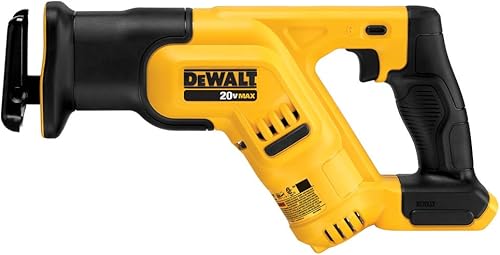
- 14 in total length
- 1-1/8 in stroke length
- 4-position blade clamp
A compact DeWalt with a four-position blade clamp, LED and pivoting shoe. Battery and charger are sold separately.
Pros
- Compact 14 in total length
- Four-position blade clamp
- LED and pivoting shoe
Cons
- Battery and charger sold separately
- Different battery platform from Ryobi ONE+
The DeWalt has a 1-1/8 in stroke, a variable-speed trigger up to 2,900 SPM, an LED and a four-position blade clamp. Its 14 in total length is shorter than the Ryobi's listed 17.09 in length.
It is sold as a bare tool, with battery and charger sold separately. Choose it if you already use DeWalt 20V MAX batteries and want its stated clamp positions or LED.
How should you use a reciprocating saw safely?
Use a reciprocating saw with eye protection, a secure workpiece and a blade suited to the material. Read the manual before fitting a blade or starting a cut.
Unplug a corded saw or remove the battery before changing the blade. Check the blade is locked in place, then make sure the work area is clear of wiring, pipes and other hidden hazards.
Start with a controlled trigger pull and keep the shoe against the work when the cut allows. Don't force the tool; stop if the blade binds, the work shifts or the saw behaves unexpectedly.
The guide to using a reciprocating saw at home covers setup, blade choice and cutting technique. For a breakdown of how the tool moves its blade, read how a reciprocating saw works.
Is the Ryobi ONE+ 18V reciprocating saw worth choosing?
The Ryobi PCL515B makes the most sense for existing ONE+ users who want a 1 in stroke and up to 3,400 SPM. Its tool-only setup is the main buying constraint, so verify your battery and charger before choosing it.
Pick the Ryobi if its battery platform fits your tools. Choose the Black+Decker if you need the included battery and charger, or compare the DeWalt if its four-position clamp and shorter stated length suit your work area.
Frequently asked questions
Does the Ryobi ONE+ 18V reciprocating saw include a battery?
No. The Ryobi PCL515B is sold as a tool only, with the battery not included.
Check whether you already have a compatible Ryobi ONE+ 18V battery and charger, and account for those separately if you don't.
What is the Ryobi PCL515B stroke length?
The Ryobi PCL515B has a 1 in stroke length and a variable speed of up to 3,400 SPM. Those figures help with comparing saws, but they don't predict how quickly a cut will finish across different materials and blades.
Is the Ryobi saw a good choice for tight spaces?
The Ryobi PCL515B is 17.09 in long, so compare its size with the space you need to reach. The Craftsman is listed at 14.5 in, while DeWalt gives a 14 in total length and a four-position blade clamp for positional flexibility.
How does the Ryobi compare with the DeWalt DCS387B?
The Ryobi offers up to 3,400 SPM and a 1 in stroke, while the DeWalt has a 1-1/8 in stroke, up to 2,900 SPM and a four-position blade clamp. Both are tool only, so choose based on your battery platform and the features that fit your cuts.