How Much Does a Reciprocating Saw Cost?
A reciprocating saw costs the least when you buy corded, where a full-size 12 amp model is the best value for most buyers. Cordless saws cost more once you count batteries and chargers, and the blade set adds a small extra cost.
On this page (8 sections)
- How much does a reciprocating saw cost by type?
- Why does a corded reciprocating saw give the best value?
- How much do you save or spend with a cordless saw?
- What does a blade set add to the total?
- How much does a reciprocating saw cost compared with other saws?
- Does a higher price mean a better reciprocating saw?
- What else changes the price you pay?
- How should you set a reciprocating saw budget?
A reciprocating saw costs the least when you buy corded, where a full-size 12 amp model is the best value for most buyers. Cordless saws cost more once you count batteries and chargers, and blades add a small extra cost on top.
The headline figure is only part of the answer. What you pay depends on the power source, the size of the saw and whether you already own batteries in that brand's system.
How much does a reciprocating saw cost by type?
A corded saw is the cheapest way into real cutting power. You plug it in and get full speed from the first pull of the trigger, with no battery to buy or charge.
Cordless saws cost more as a set. The bare tool is one part of the bill, and a battery and charger turn it into a working saw.
If you already own tools in that battery system, the extra cost drops sharply.
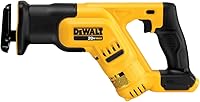
Compact saws sit at the low end of both types. They cut slower and reach tighter spots, so they suit light jobs more than demolition.
A full-size saw costs more but does the heavy work faster.
| Type | What drives the cost | Best for |
|---|---|---|
| Corded full-size | Motor size and stroke length | Most buyers and heavy cutting |
| Cordless bare tool | Battery platform and motor | Owners already in that system |
| Cordless kit | Tool, battery and charger | Buyers starting from zero |
| Compact saw | Smaller motor and shorter stroke | Tight spots and light jobs |
Why does a corded reciprocating saw give the best value?
Because the price covers the whole saw. You don't buy a battery, a charger or a second battery later, and the tool runs as long as the cord reaches an outlet.
The DeWalt DWE305 shows what a corded saw brings. Its 12 amp motor is built for heavy-duty work, and the 0–2,900 spm speed with a 1-1/8 in stroke length cuts fast.
A 4-position blade clamp lets you flush cut, and the keyless lever-action clamp makes blade changes quick.
The tool weighs 8 pounds and measures about 19.38 in long. That heft is part of why it holds steady in demolition, and it's also the reason a compact saw exists for tight spots.
The trade-off is the cord. You need an outlet nearby and an extension cord for outdoor work, which matters on a roof or at the back of a yard.
How much do you save or spend with a cordless saw?
A cordless saw costs more up front, but the gap depends on the batteries you already own. If you're already in a brand's battery system, the bare tool is the only new cost.
The Ryobi ONE+ 18V is a bare tool, so the battery and charger are separate. It runs at 3,400 spm with a 1 in stroke length and weighs 3.75 lb, which makes it easy to carry and use one-handed in tight spots.
For light cuts away from an outlet, that portability is the point.
The higher speed rating doesn't erase the shorter stroke. Speed and stroke length work as a pair, so the 1 in stroke of the Ryobi and the 1-1/8 in stroke of the DeWalt describe different cutting styles rather than a straight ranking.
Compare the stroke when you price the two side by side.
For a first saw with no batteries at home, the cordless route costs more than a corded model. For someone with several ONE+ tools already, the same saw costs less than switching brands.
That's why the answer to what is a reciprocating saw good for often decides the power source: yard work and remote jobs favor cordless, while shop and demolition work favor corded.
What does a blade set add to the total?
Blades are a small but real part of the cost, and a set covers more jobs than the one blade in the box. Many saws ship with a single blade or none, so budget for blades with the saw.
The DeWalt 12-piece bi-metal set covers wood, metal and demolition work. Bi-metal construction gives the blades flexibility and a long cutting edge, and the tall, thick profile holds straight cuts in heavy metal.
The set comes in a ToughCase that expands to hold 9 in blades and fits into a DeWalt tool kit box.
That range means you don't stop work to buy a metal blade after the wood blade dulls. DeWalt says the tooth forms give up to 50% longer life than its prior generation blades.
The set is made in the USA with global materials.
What's inside the 12-piece set?
The kit packs three 6-inch 6-TPI woodcutting blades, two 6-inch 18-TPI metal blades, three 8-inch 14-TPI metal blades, three 9-inch 6-TPI woodcutting blades and one 9-inch 10-TPI demolition blade. The tooth count changes what each blade does: 6 TPI clears chips fast in wood, 14 and 18 TPI leave a cleaner edge in metal, and 10 TPI holds up in demolition.
That spread is why the set fits the saw's whole job list instead of one material. The blades are built on Matrix II steel with 8% cobalt for the cutting edge.
The set carries a 3-year warranty on material and workmanship.
How much does a reciprocating saw cost compared with other saws?
A reciprocating saw usually costs less than a circular saw or a miter saw of similar build. It's a rough-cutting tool, so you don't pay for the precision table and fence those saws carry.
That lower cost is why it's a common first power tool. It handles demolition and pruning that a circular saw can't, and it reaches into tight spots a miter saw can't touch.
The trade-off is cut quality. A reciprocating saw leaves a rougher edge, so it isn't the saw for finished trim.
When you price a saw, compare it against the job. If you need clean, straight cuts in lumber, put the money toward a circular saw and add a recip saw later.
If you need to break down pallets, cut pipe or prune branches, a reciprocating saw does the work for less.
Does a higher price mean a better reciprocating saw?
Not always. Price tracks motor size, stroke length, blade clamp design and battery platform more than it tracks brand name.
Check the features that change the work. A 4-position blade clamp, like the one on the DWE305, adds flush-cutting ability.
A variable speed trigger lets you start slow in metal and speed up in wood. A keyless clamp saves time on blade changes.
A higher price buys more power and faster cutting, not just a label. A budget saw with a good clamp and a variable speed trigger can handle most home jobs.
Spend more when the work is heavy or daily. For a closer look at what the tools do, see how does a reciprocating saw work.
What else changes the price you pay?
The extras around the saw often matter more than the saw's own cost. A corded saw needs an extension cord for outdoor work.
A cordless saw needs a second battery for long jobs.
Blade choice changes the running cost too. A wood blade dulls fast in metal, so the right blade per material keeps the saw useful longer.
A set with wood, metal and demolition blades covers the mix. Check the blade shape as well: the rectangular profile is what holds the straight line in heavy cutting.
Battery platform is the biggest hidden cost in cordless. If you switch brands, you buy into a new system.
If you stay in one, every new bare tool costs less. That's the same logic behind the Makita reciprocating saw line, where buyers already in that battery system get more for their money.
How should you set a reciprocating saw budget?
Set the budget by your power source first, then add blades. A corded saw leaves more room for a blade set and still costs less than a cordless kit for a first-time buyer.
Pick corded if you work near outlets and want the most cutting power for the money. Pick cordless if you already own batteries or work away from power.
Add a blade set that matches your materials, since the one blade in the box won't cover everything. The 12-piece set also answers the storage question, since the case nests inside a tool kit box.
If you're still comparing models, the guide to what is the best reciprocating saw weighs the trade-offs. The short version on how much a reciprocating saw costs: corded gives the best value, cordless costs more up front and saves later if you're already in the battery system.
Frequently asked questions
How much does a reciprocating saw cost for a first-time buyer?
A corded 12 amp saw is the best first buy for most people because it gives full power from a wall outlet. It costs less than a cordless kit once you add batteries, and you can put the saved money into a blade set.
Is a cordless reciprocating saw more expensive than a corded one?
Yes, once you buy batteries and a charger. The bare tool is one part of the cost, and a second battery plus a charger pushes the total above a corded saw.
That extra cost buys you freedom from an extension cord.
Do reciprocating saws come with blades?
Many saws ship with one blade or none at all. Plan on buying a blade set for the materials you cut, since a wood blade won't handle metal or demolition work.
A 12-piece bi-metal set covers the common jobs.
What costs more, a compact reciprocating saw or a full-size one?
A full-size saw costs more than a compact one, but it also cuts faster and handles demolition better. A compact model suits tight spots and light jobs.
Pick the size by the work, not just by the lower cost.