What Is a Brushless Reciprocating Saw?
A brushless reciprocating saw uses a motor with no carbon brushes, so the magnets switch electronically instead of rubbing against the spinning part. That makes it more efficient and longer lasting than a brushed saw, and it usually delivers more runtime and power per battery charge.
On this page (8 sections)
- What does brushless actually mean in a reciprocating saw?
- How does a brushless motor differ from a brushed one?
- Why does brushless matter more on a cordless reciprocating saw?
- Do you need brushless for light home use?
- What are the downsides of a brushless reciprocating saw?
- What specs matter more than the motor type?
- How do you choose between brushless and brushed?
- What is a brushless reciprocating saw best for?
A brushless reciprocating saw uses a motor with no carbon brushes, so the magnets switch electronically instead of rubbing against the spinning part. That makes it more efficient and longer lasting than a brushed saw, and it usually delivers more runtime and power per battery charge.
The short version: brushless means fewer wearing parts and less wasted energy. You pay more up front, but you get a saw that runs longer on a battery and should last through more jobs.
Everything else about the saw, from the blade clamp to the stroke length, still decides how well it cuts.
What does brushless actually mean in a reciprocating saw?
Brushless means the motor has no carbon brushes touching the spinning armature. A brushed motor sends current through two carbon blocks that press against a spinning commutator, and those blocks slowly wear away.
A brushless motor uses a circuit board to switch the magnetic field instead.
That change removes the main wear part. It also lets the motor run cooler and turn more of the battery's energy into blade movement rather than heat.
Brands build these motors into their cordless saws, which is why "brushless" and "cordless" so often appear together.
The benefit is simple to picture. A brushed motor wastes energy at the brush contact; a brushless one sends more of it to the blade.
That is why brushless saws tend to cut longer per charge and feel stronger under load.
How does a brushless motor differ from a brushed one?
A brushed motor rubs carbon against a spinning part to move current; a brushless motor switches current electronically. The brushed design is cheaper to build and still works well for light, occasional cutting.
The brushless design costs more but holds its speed better and lasts longer.
The practical differences show up in four places:
- Efficiency: less energy is lost to friction and heat, so more goes into the cut.
- Runtime: a brushless saw usually makes more cuts per battery charge.
- Lifespan: no brushes to replace means fewer motor failures over time.
- Control: electronic switching responds faster to changing load, so speed stays steadier in thick material.
For a saw that gets used on demolition, pruning, or pipe cutting, those gains add up. For a saw that comes out twice a year, a brushed model can still do the job at a lower price.
Why does brushless matter more on a cordless reciprocating saw?
On a cordless saw, every bit of efficiency stretches the battery you already own. A reciprocating saw is a hungry tool because it drags a blade back and forth through tough material, and a brushed motor loses part of each charge to friction.
Brushless motors recover some of that.
Stroke length and speed still set the pace. The DeWalt DCS384B runs a 1-1/8 in. stroke at up to 3,000 SPM (no-load) and DeWalt rates it at up to 102 cuts per charge in 2x12 pine.
The Milwaukee M18 FUEL Sawzall reaches 3,000 SPM as well. The brushless design helps each one hold speed as the blade bites.
If you cut a lot of pipe, lumber, or tree limbs, the runtime gain is the reason to pay more. To see where these saws fit in the wider lineup, the guide to how does a reciprocating saw work covers the blade motion and stroke in detail.
What does the Milwaukee M18 FUEL Sawzall bring?
The Milwaukee M18 FUEL Sawzall pairs a brushless motor with a wear-resistant lever-actuated blade clamp for fast blade changes. It runs up to 3,000 SPM and includes a built-in LED that lights the cut line.
It's a bare tool, so you supply the M18 battery and charger. The metal-reinforced battery connection is built to keep the pack seated through heavy vibration.
This is the saw to pick if you already own Milwaukee batteries and want full-size cutting power.
Do you need brushless for light home use?
No. If you cut a few branches and one fence board a year, a brushed cordless saw does the job for less money.
The brushless premium pays off through runtime and motor life, and light use won't wear out brushes quickly anyway.
The case for brushless grows when the saw becomes a regular tool. Three signs point that way:
- You cut for an hour or more at a time and swap batteries mid-job.
- You work through metal pipe, nails, or demolition debris where the motor strains.
- You want one saw to last several years of projects.
If none of those fit, a brushed saw leaves more budget for blades. A sharp, correct blade makes a bigger difference to cut speed than the motor type does.
Our overview of what is a reciprocating saw good for lists the jobs where either motor type works fine.
Which compact saw suits one-handed work?
The Makita XRJ08Z is a compact one-handed brushless recip saw built for tight spots. Its brushless motor delivers 0 to 3,100 SPM with a 7/8 in. stroke, and Makita says the low-vibration design cuts vibration by up to 40% compared with the XRJ07ZXB.
The loop-shaped handle guard adds rigidity, and the one-handed grip is shaped to push force into the workpiece. The bare tool weighs just 16 ounces before you add a battery.
Makita rates it at up to 90 cuts in 2x10 lumber and up to 50 cuts in 1 in. schedule 80 steel pipe with a 5.0Ah pack. It ships with wood, all-purpose, and metal blades.
This is the pick for overhead cuts, plumbing between joists, and pruning where a full-size saw is awkward. If you want to compare it with the rest of the brand's range, the roundup of the Makita reciprocating saw models shows the options.
What are the downsides of a brushless reciprocating saw?
The main downside is price, and the second is that a failed circuit board costs more to fix than a worn brush. Brushless saws also need the right battery platform to give their best runtime.
Neither point rules them out, but both are worth knowing.
On cost, a brushless saw sits above a brushed model with similar stroke and speed. You're paying for efficiency and motor life, and the gap only closes over years of use.
On repair, brushes are cheap parts; an electronic controller is not. That's a rare failure, but it's the trade-off for the design.
There's also a marketing trap. "Brushless" gets printed on saws that differ widely in stroke length, blade clamp quality, and weight.
A brushless motor doesn't make a short-stroke, heavy saw into a good cutter. Judge the whole tool.
What specs matter more than the motor type?
Stroke length, speed, weight, and blade changes decide how a saw feels in your hands. The motor type sits underneath those, helping them work better but not replacing them.
Check these before you decide brushless is the answer.
- Stroke length: a longer stroke clears more material per pass. The DeWalt DCS384B runs 1-1/8 in.; the Makita XRJ08Z runs 7/8 in. as a compact.
- Speed: strokes per minute set the pace in wood and soft material. The DeWalt and Milwaukee top out at 3,000 SPM (no-load), while the Makita reaches 3,100 SPM.
- Weight: a lighter saw tires you less overhead. The DeWalt weighs 4.5 lbs as a bare tool; the Milwaukee weighs 6.8 lbs.
- Blade clamp: a lever or keyless clamp saves time on every blade change. The Milwaukee uses a lever-actuated clamp and the DeWalt uses a keyless lever-action clamp.
- Vibration control: a counterweight reduces fatigue. Makita and DeWalt both build one in.
Which full-size saw balances stroke and weight?
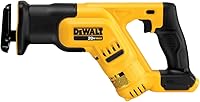
The DeWalt DCS384B XR is a full-size brushless saw with the longest stroke of the three at 1-1/8 in. DeWalt calls it its fastest cutting 20V MAX reciprocating saw and rates it at up to 102 cuts per charge in 2x12 pine.
It runs a variable speed trigger up to 3,000 SPM (no-load) and has a pivoting shoe for more points of contact on the material. A counterbalance mechanism limits vibration, and an onboard LED lights the work area.
It weighs 4.5 lbs as a bare tool and includes one wood cutting blade.
This is the saw to pick if stroke length and a light body matter more to you than the Milwaukee's full-size grip. For a wider view of cordless options, the roundup of what is the best reciprocating saw compares the top models.
How do you choose between brushless and brushed?
Pick brushless if you cut often, want more cuts per charge, and plan to keep the saw for years. Pick brushed if the saw is for occasional weekend jobs and you'd rather spend the difference on blades.
That's the whole decision in one line.
Battery platform decides as much as the motor. A brushless saw that needs a new battery system costs more than its sticker price suggests.
Check the voltage and whether the saw comes as a bare tool or a kit. A compact one-handed saw like the Makita XRJ08Z suits overhead and tight work; a full-size saw like the Milwaukee M18 FUEL or DeWalt DCS384B gives more reach and a longer stroke for demolition.
Grip shape matters as much as the numbers, so handle both if you can.
What is a brushless reciprocating saw best for?
A brushless reciprocating saw is best for frequent cutting, long runtime, and tools that need to last. It shines in demolition, pipe and lumber cutting, pruning, and any job where you work through several batteries in a session.
The efficiency gain shows up as more cuts per charge and a cooler-running motor.
If the saw is a workhorse, buy brushless and match it to your battery platform. If it's an occasional helper, a brushed saw still earns its place.
Either way, budget for a few good blades in wood, metal, and demolition styles. Start with the three saws above: the Milwaukee M18 FUEL Sawzall for full-size power and a lever blade clamp, the Makita XRJ08Z for one-handed and overhead work, and the DeWalt DCS384B for the longest stroke and lightest body.
Each is a bare tool, so check which batteries you already have before you order.
Frequently asked questions
Are brushless reciprocating saws worth the extra cost?
For most buyers who cut regularly, yes. A brushless motor turns more of each battery charge into blade strokes, so a cordless saw runs longer and lasts longer than a brushed model at a similar power level.
Do brushless saws need less maintenance?
Yes. There are no carbon brushes to wear down and replace, so the motor's main wear point is gone.
Blades and the blade clamp still need attention, but the motor itself asks less of you over its life.
Can a brushless motor run on the same battery as a brushed saw?
Often, yes, within the same brand's battery platform. A brushless tool draws current more efficiently, but it still needs the correct voltage and connector for that brand's packs, so match the saw to the batteries you already own.
Is a brushless saw quieter than a brushed one?
Usually a little quieter and smoother at the motor, though the blade cutting through wood or metal is the main noise source. The bigger practical gains are longer runtime and more consistent speed under load.