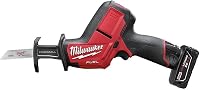
Milwaukee M12 Hackzall vs M18 Hackzall: Which Is Better? (November 2026)
The Milwaukee 2719-20 M18 FUEL Hackzall is the better overall pick, while the Milwaukee 2625-20 M18 Hackzall suits buyers who want a simpler compact saw. Compare stroke length, control, blade changes and battery system before choosing.
On this page (11 sections)
- Milwaukee M12 Hackzall vs M18 Hackzall: the quick answer
- How do the 2 Milwaukee Hackzalls compare?
- Which Hackzall cuts faster?
- Does stroke length matter for daily work?
- Which model gives better control?
- Which Hackzall is better for tight spaces?
- Which one makes blade changes easier?
- How do the batteries affect the choice?
- Who should buy the 2719-20 M18 FUEL Hackzall?
- Who should buy the 2625-20 M18 Hackzall?
- Which Milwaukee Hackzall should you choose?
The Milwaukee 2719-20 M18 FUEL Hackzall wins the Milwaukee M12 Hackzall vs M18 Hackzall comparison for most buyers. It combines a 7/8 in stroke length, 4500 rpm speed, POWERSTATE Brushless Motor, REDLINK Plus Intelligence and a pivoting shoe.
The Milwaukee 2625-20 M18 Hackzall is the better fit for a simpler one-handed saw with a quick-lock blade clamp and built-in LED light. Both are Bare Tool models, so your battery choice is part of the buying decision.
This comparison focuses on the product data for these 2 saws. It does not treat them as full-size reciprocating saws, since the compact one-handed form is central to how both models are used.


Milwaukee M12 Hackzall vs M18 Hackzall: the quick answer
Pick the Milwaukee 2719-20 for faster cutting and stronger control features. Its 7/8 in stroke, 4500 rpm speed, brushless motor and pivoting shoe give it the clearest advantage for demanding cutting jobs.
Pick the Milwaukee 2625-20 for compact overhead work and easy blade changes. Its one-handed design, anti-vibration handle, LED light and QUIK-LOK blade clamp make it straightforward for branches, PVC pipe, lumber and some metal work.
The product names can cause confusion because this matchup is between 2 M18 models. The 2719-20 is the M18 FUEL Hackzall, while the 2625-20 is the M18 18-Volt Lithium-Ion Cordless Hackzall.
If you were actually comparing Milwaukee's M12 and M18 battery platforms, read our M12 Hackzall vs M18 Hackzall for home DIY guide for that battery-system decision.
The key difference is not simply the word FUEL in one product name. The 2719-20 brings its motor, electronics and pivoting shoe into the cutting decision, while the 2625-20 puts more emphasis on a compact grip, light and blade clamp.
How do the 2 Milwaukee Hackzalls compare?
The 2719-20 has the stronger cutting specification, while the 2625-20 keeps the controls simple. Both use a compact one-handed format and come as Bare Tool models.
| Feature | Milwaukee 2719-20 M18 FUEL Hackzall | Milwaukee 2625-20 M18 Hackzall |
|---|---|---|
| Model | 2719-20 | 2625-20 |
| Stroke length | 7/8 in | 3/4 in |
| Stated speed | 4500 rpm | 0–3,000 strokes per minute |
| Motor or drive feature | POWERSTATE Brushless Motor | Brushless |
| Control features | Pivoting shoe, REDLINK Plus Intelligence | Anti-vibration handle, built-in LED light |
| Blade change | Not named in the supplied product data | QUIK-LOK blade clamp |
| Body size | 14 x 3.31 x 7 in | 13.39 x 3.23 x 7.2 in |
| Listed weight | 1.8 kg | Not used as a comparison point here |
| Included item | Bare Tool | Bare Tool |
The 2719-20 has a slightly longer body and a 7/8 in stroke. The 2625-20 has a shorter listed length and a 3/4 in stroke, with a design centered on compact handling.
Their blade details are also similar in basic form. Both use rectangular High Speed Steel blades and list metal as a recommended surface, so the main split is the saw's drive and control setup rather than a different basic blade shape.
Which Hackzall cuts faster?
The Milwaukee 2719-20 is the faster-cutting choice on the stated specifications. Its 4500 rpm speed and 7/8 in stroke length put more cutting movement into each cycle than the 2625-20's 0–3,000 strokes per minute and 3/4 in stroke.
Stroke length describes how far the blade travels during each reciprocating cycle. A longer stroke removes more material with each stroke, so the 2719-20 is the better match for repeated cuts where time and material removal matter.
The 2719-20 also uses a POWERSTATE Brushless Motor. Milwaukee pairs that motor with REDLINK Plus Intelligence, which coordinates the tool, battery and charger for optimized performance and overload protection.
The product description also connects the 2719-20's motor and electronics with longer tool life than competitive one-handed reciprocating saws. That is a durability claim from the product data, not a reason to assume every job will have the same result.
That combination makes the 2719-20 the clear choice for heavier cutting demands within this comparison. The 2625-20 remains useful when your jobs are smaller and its simpler controls matter more than maximum cutting speed.
Does stroke length matter for daily work?
Stroke length matters most when you make repeated cuts through material and want each blade cycle to remove more. The 2719-20's 7/8 in stroke gives it a direct advantage over the 2625-20's 3/4 in stroke.
A 3/4 in stroke is still suited to a compact reciprocating saw. It keeps the 2625-20 useful for cutting branches, PVC pipe, lumber and some metals, especially when the one-handed shape helps you position the tool.
The difference is not only a number on a table. A longer stroke can make the faster model feel better suited to jobs where the blade must keep moving through material, while the shorter stroke fits a lighter-duty approach.
The stroke also works with the tool's other features. On the 2719-20, the longer travel is paired with the POWERSTATE motor and pivoting shoe.
On the 2625-20, the shorter travel is part of a package built around compact movement, the anti-vibration handle and easier blade changes.
Blade choice still matters. Use a blade intended for the material and make sure the workpiece is supported before you start.
For a broader look at Milwaukee's compact and full-size options, our Best Milwaukee Sawzall and Hackzall saws guide compares the role of each saw type.
Which model gives better control?
The Milwaukee 2719-20 offers the stronger cutting-control package because its pivoting shoe keeps contact with the workpiece. The 2625-20 counters with an anti-vibration handle and a compact body that supports one-handed movement.
A pivoting shoe helps the 2719-20 maintain contact as the cut changes. That supports smoother cut starts and reduces bucking during use.
The product description also gives the 2719-20 a dual gear counterbalance mechanism and up to 4x lower vibration than traditional reciprocating saws. That makes vibration part of its control design, not just a comfort detail.
The 2625-20's anti-vibration handle is the more direct comfort feature. Its textured handle and one-handed design suit jobs where you need to move around the workpiece or hold the saw overhead.
The right winner depends on the motion you make most often. Pick the 2719-20 for contact and cutting stability, or the 2625-20 when a compact grip and lower hand fatigue matter more to your work pattern.
Which Hackzall is better for tight spaces?
The Milwaukee 2625-20 is the simpler pick for tight-space and overhead work. Its compact 13.39 x 3.23 x 7.2 in body, one-handed design and built-in LED light suit cuts where room and visibility are limited.
The 2719-20 is also designed for one-handed use and tight spaces. Its listed dimensions are 14 x 3.31 x 7 in, so it is close in overall size while adding the longer stroke and pivoting shoe.
The 2625-20's LED light illuminates the work surface while cutting. That is useful when the tool or your hand casts a shadow across the line.
The dimensions do not create a large size gap between these saws. The more useful question is what you need to do after getting the tool into the space: the 2625-20 helps with visibility and simple positioning, while the 2719-20 adds cutting capacity in a similarly compact format.
Choose by the feature you will notice most. If access and light are the main problems, the 2625-20 makes the better case.
If the space is tight but the cut itself is demanding, the 2719-20's cutting system is stronger.
Which one makes blade changes easier?
The Milwaukee 2625-20 wins for clearly defined blade-change convenience. Its QUIK-LOK blade clamp is designed for fast, tool-free changes between SAWZALL blades and HACKZALL blades.
That feature matters when one job moves between materials or when you need to replace a blade without bringing another tool to the work area. The clamp is positioned near the front of the saw for quick access.
A quick-lock clamp also fits the 2625-20's broader role. Its LED light and one-handed body help you work in a restricted position, while the clamp reduces the number of steps needed when the blade has to change.
The 2719-20 has the stronger cutting package, but the supplied product details do not name a blade-change system for it. Keep the choice focused on the features that are documented for each model.
Blade condition affects both saws. A suitable sharp blade keeps the cut controlled, while a worn blade makes the tool work harder and can slow the job.
How do the batteries affect the choice?
Both saws are Bare Tool models, so neither comparison includes a battery in the box. The 2625-20 is explicitly compatible with Milwaukee M18 lithium-ion batteries, including M18 XC high-capacity and M18 compact batteries.
The 2719-20 uses Milwaukee's REDLITHIUM battery technology and is part of the M18 system. REDLINK Plus Intelligence coordinates the tool, battery and charger, while the product data identifies 1 lithium-ion battery as required.
The 2719-20's battery electronics are part of its performance system. Milwaukee describes the REDLITHIUM technology as supporting pack construction, electronics and work per charge, while REDLINK Plus adds communication and overload protection.
This makes the battery platform more important than a small body-size difference. If you already use M18 batteries, either model fits that system, and the decision can stay focused on speed, control and convenience.
Plan the purchase around the complete setup. A Bare Tool box gives you the saw itself, while the battery system supplies the cordless power needed for operation.
Who should buy the 2719-20 M18 FUEL Hackzall?
Buy the Milwaukee 2719-20 M18 FUEL Hackzall if you want the strongest cutter in this matchup. The 9.3 score reflects its longer 7/8 in stroke, 4500 rpm speed, POWERSTATE Brushless Motor and pivoting shoe.
It suits people who make repeated cuts and want material removed quickly. The one-handed design also keeps it useful in tight spaces and overhead positions, while the pivoting shoe supports smoother contact with the workpiece.
The 2719-20 has the more advanced electronics package in this comparison. REDLINK Plus Intelligence provides optimized performance and overload protection through communication between the tool, battery and charger.
It also makes sense when vibration is a major concern during repeated cuts. The product description connects its counterbalance system with up to 4x lower vibration than traditional reciprocating saws, and its rubber seal and weep holes are described as protection against water and debris.
Its trade-off is simple: this is the more feature-heavy choice, but it is still a Bare Tool. Choose it when the cutting advantage matters enough to justify selecting the battery separately.
Our Milwaukee Hackzall review looks more closely at the 2719-20's role for buyers who want one-handed M18 cutting.
Who should buy the 2625-20 M18 Hackzall?
Buy the Milwaukee 2625-20 M18 Hackzall if you value simple controls, compact handling and fast blade changes. Its 8.5 score reflects a practical design rather than the faster cutting specification of the 2719-20.
This model suits overhead work, tight access and jobs that move between branches, PVC pipe, lumber and some metals. The one-handed grip gives you room to position the saw, while the built-in LED light helps keep the work surface visible.
The QUIK-LOK blade clamp is its clearest daily-use advantage. You can change compatible blades without a separate tool, which helps when the job changes quickly.
Its anti-vibration handle adds another reason to choose it for work that involves thicker pieces of lumber. The design combines that handle with a compact body, textured grip and one-handed operation.
Its trade-off is the shorter 3/4 in stroke and lower stated speed range. Pick it when convenience and compact control are more valuable than the highest cutting output.
Which Milwaukee Hackzall should you choose?
Choose the Milwaukee 2719-20 for speed, stroke length and cutting control. Choose the Milwaukee 2625-20 for overhead handling, LED visibility and quick blade changes.
The overall winner is the 2719-20 because it earns the higher score and brings more cutting-focused features to the comparison. The POWERSTATE Brushless Motor, REDLINK Plus Intelligence, 7/8 in stroke and pivoting shoe all support that decision.
The 2625-20 is not a weak alternative. Its compact design, anti-vibration handle, LED light and QUIK-LOK clamp make it the better fit for a buyer whose work depends on access and fast setup.
Think of the choice as a priority match. Select the 2719-20 when each cut should remove more material and the shoe, motor and electronics matter.
Select the 2625-20 when the tool needs to be easy to position, illuminate the work and accept quick blade changes.
For the wider difference between a one-handed Hackzall and a full-size Sawzall, read Milwaukee Sawzall vs Hackzall: which one to buy. For this specific Milwaukee M12 Hackzall vs M18 Hackzall decision, choose the 2719-20 unless the 2625-20's simpler overhead-work features match your jobs more closely.
Frequently asked questions
Are these Milwaukee Hackzall saws sold with a battery?
Both models are Bare Tool versions, so the box includes the tool rather than a battery. The 2719-20 uses a lithium-ion battery system, while the 2625-20 works with Milwaukee M18 lithium-ion batteries.
Which Milwaukee Hackzall has the longer stroke?
The Milwaukee 2719-20 M18 FUEL Hackzall has the longer stroke at 7/8 in. The Milwaukee 2625-20 M18 Hackzall has a 3/4 in stroke, so the 2719-20 removes more material with each stroke.
Can both Hackzall models cut metal?
Both models list metal as a recommended surface and use rectangular High Speed Steel blades. Choose a blade suited to the material and keep the work secure before cutting.
Which Hackzall is easier to use overhead?
Both use a one-handed compact design, but the Milwaukee 2625-20 has a lighter listed weight of 1.8 kg and built-in LED lighting. That combination makes it the simpler choice for overhead work in dim areas.
Is the Milwaukee 2719-20 worth choosing over the 2625-20?
Choose the 2719-20 when its 7/8 in stroke, 4500 rpm speed, brushless motor and pivoting shoe match your work. Choose the 2625-20 when its quick-lock clamp, LED light and compact M18 design matter more.